 Helmet Horizon
Build note 02 · Origins
Before the Horizon, There Was Space
How a small SpriteKit experiment spent years looking for a game — until a rough lunar rover and a helmet-shaped sketch finally gave it one.
A framework to explore
Around 2015, I was working as an iOS developer at a creative digital agency, where our team regularly researched new Apple technologies and presented them to one another. Having worked in game development before, I knew immediately which one I wanted to pick: SpriteKit.
For my presentation, I built a small spacecraft that could be controlled by applying different forces to it. It could lift objects with a magnetic pull and fly away from the surface of the planet. The farther it moved from the surface, the darker the sky became. Beyond a certain altitude, gravity was switched off, allowing the spacecraft to float freely.
There was no plan for a complete game. But as I tested one feature after another, the demo began to feel like the start of something larger.
That demo became a project called Space.
A project without a destination
I kept returning to the Space project in my free time. Over time, I added a gradient sky, procedurally generated star fields, an astronaut who could leave the spacecraft, and eventually a lunar rover. There were now three things to control, but still no answer to the most important question: what was the game actually about?
The project moved in bursts, with long pauses in between. Every time I came back, I brought new ideas with me: underground stations, access cards, environmental puzzles and a story stretching across planets.
The problem wasn’t a lack of ideas. Nearly every idea was too big for how I was really working. I was still thinking as if I had an entire game-development team behind me, when in reality I was working alone, in my spare time, without a dedicated artist.
Following the fun
Letting go of the original vision seemed like the sensible choice. Throwing away years of code didn’t. Instead, I looked at what already worked and asked which parts were worth keeping.
The rover was a rough experiment, yet driving it over objects, tipping it over and trying to get it back onto its wheels was unexpectedly entertaining. My daughter seemed to agree: whenever she tried the prototype, she was more interested in playing with the rover than in flying the spacecraft.
The rover had started as one small part of a much larger idea, but it became the clue to a smaller, more achievable game.
Enter the helmet
I began sketching different vehicle ideas. The vehicle needed to be easy to control, and its shape had to help it get back onto its wheels after tipping over. That led me away from rectangular bodies and toward rounder forms.
The first version was a rounded square, decorated with Oscar — a camel inspired by my daughter Olivia’s favorite one from a family trip to Egypt. The shape worked, but it still felt like a box on wheels. A circle would work even better, but on its own, it was just a circle.
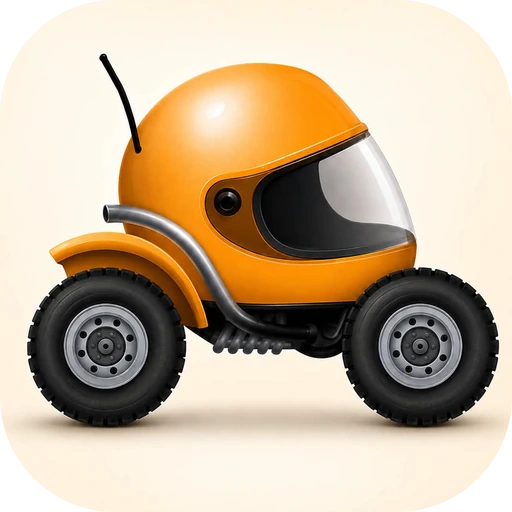
Then one of the sketches began to look like a motorcycle helmet. The shape finally felt right: it gave the vehicle character and created an obvious place for a driver inside.
With the helmet shape in place, the vehicle began to come alive. Its shield moved with the forces acting on it, the driver leaned with every bump, and a small antenna bounced in every direction.
Together, these simple parts turned a moving object into a character. For the first time, it felt less like a physics test and more like the beginning of a game.
A direction at last
The level design was far from ready, and the vehicle needed much more tuning. For a long time, the track was built on solid ground rather than the steel elements used in the finished game. From then on, the track and the vehicle developed together, each shaping what the other needed to become.
There was a long way to go, but the project had finally found its direction.
The Xcode project, however, is still called Space.